


 English
 русский
 Español
 عربى
عربىFrom a piece of steel plate to the entire vehicle frame: How important are automotive stamping parts?
In the manufacturing process of a car, the engine, three-electric system, and smart cockpit are often more likely to attract consumers' attention, but what really determines whether a car has strong bones and a stable foundation are those seemingly inconspicuous stamping parts of the car. Starting from the initial steel plate, through stamping, forming, connection and assembly, the safety frame and structural foundation of the entire vehicle are finally constructed. It can be said that without high-quality automotive stamping parts, it is impossible to have complete vehicle safety, quality and performance in the true sense.
Content
1. What are automotive stamping parts?
In automobile manufacturing, automobile stamping parts are one of the foundations of vehicle production. Whether it is body structure, safety performance, appearance quality and assembly accuracy, they are all closely related to stamped parts. Although they are often hidden inside the car body and are not easily visible to consumers, they play an important role as the "car skeleton". Understanding what automotive stamping parts are will help you gain a more comprehensive understanding of the core logic of automotive manufacturing.
(1) Definition of automotive stamping parts
Automobile stamping parts refer to automobile parts that are made of metal sheets (such as steel plates, aluminum plates, etc.) as raw materials and processed through punching, drawing, bending, flanging, shaping and other processes with the help of stamping equipment and molds. This type of parts has the characteristics of high dimensional accuracy, stable strength, and is suitable for mass production. It is one of the most widely used parts types in the automotive industry.
In vehicle manufacturing, stamping parts are mainly concentrated in the body system, forming the main structure of the body in white (BIW), and also present in some chassis and functional brackets.
(2) Main types of automotive stamping parts
According to their different functions in the vehicle, automotive stamping parts can generally be divided into the following categories:
Structural stamping parts
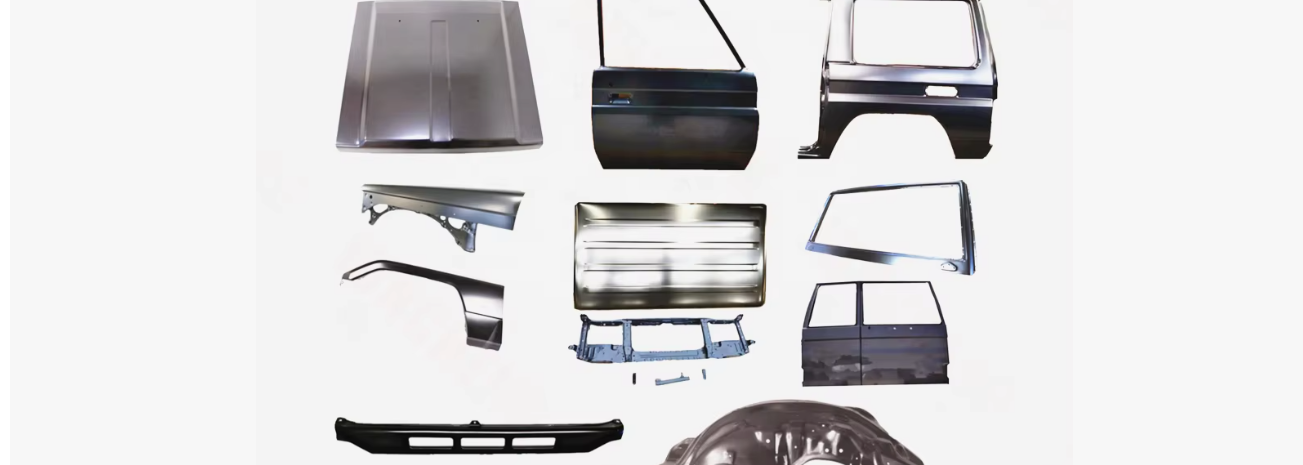
Structural parts are the most critical category of automotive stamping parts, which mainly bear the vehicle load and collision energy. For example, front and rear longitudinal beams, cross beams, sill beams, A/B/C pillars, etc. These parts directly determine the rigidity, strength and safety performance of the car body, and play a core role in protecting the passenger compartment in an accident.
Covered stamping parts
The covering parts are mainly located on the outside of the car body. They not only bear styling and aesthetic functions, but also have certain structural strength. Common covering parts include door outer panels, hoods, tailgates, fenders, etc. Such stamped parts require extremely high surface quality and forming accuracy, while also meeting pedestrian protection and lightweight requirements.
Reinforcement and functional stamping parts
Such parts are usually used for local reinforcement or functional support, such as door anti-collision beams, reinforcement plates, brackets, mounting brackets, etc. Although it is not large in size, it plays a significant role in improving local strength, stability and safety.
(3) Manufacturing process of automotive stamping parts
The production of automotive stamping parts usually starts with steel plates and is gradually formed through multiple processes.
The first is material preparation, selecting plates of different thicknesses and strength levels according to the purpose of the part. Then enter the stamping process, where blanking, drawing, punching, flanging and other operations are completed through punches and molds. Complex parts often require continuous processing of multiple molds to ensure shape and dimensional accuracy. Finally, shaping and inspection are performed to ensure the parts meet assembly and safety requirements.
This process has extremely high requirements on equipment, mold design and process control. It is a link with high technical content and investment level in automobile manufacturing.
(4) The important role of automotive stamping parts
Build the body structure skeleton
Automobile stamping parts are connected through welding, riveting, etc. to form a complete body structural frame, providing a rigid foundation for the entire vehicle. The stability of the vehicle body structure directly affects vehicle handling, safety and durability.
Determine passive safety performance
In a collision accident, the stamped structural parts absorb the impact energy through reasonable deformation and prevent the collision force from directly intruding into the passenger compartment. The energy-absorbing area of the body and the passenger compartment protective structure are almost entirely composed of stamped parts.
Affects vehicle quality and assembly accuracy
The dimensional accuracy of stamped parts determines the consistency of body assembly. If the stamping accuracy is insufficient, it will easily lead to problems such as uneven door gaps, abnormal noise, and poor sealing, which will affect the quality of the entire vehicle.
2. Why do automobile stamping parts determine the strength of the car body?
When evaluating whether a car is "strong" and "safe", people tend to focus on the core indicator of body strength. What really determines the strength of the car body is not whether it looks thick or heavy on the outside, but the large number of stamped automotive parts hidden inside the car body. Through material selection, structural design and manufacturing accuracy, they jointly build the load-bearing system and safety frame of the entire vehicle, thus essentially determining the strength of the vehicle body.
(1) What is the essence of body strength?
Body strength is not equivalent to "steel plate thickness", but refers to the body's ability to resist deformation and maintain structural integrity when subjected to external forces, which is mainly reflected in three aspects:
Overall rigidity: the body maintains shape stability during driving, steering, and bumps;
Local strength: key parts can withstand concentrated loads;
Crash performance: absorbs energy through orderly deformation in an accident and protects the passenger compartment.
These three points are almost all realized by body stamping parts.
(2) Stamping parts constitute the "mechanical skeleton" of the car body
Cars are not made from a single piece of steel, but from hundreds or even thousands of stamped parts connected together. These parts are not randomly spliced together, but are scientifically arranged to form a mechanical structure similar to "human skeleton".
For example, the front and rear longitudinal beams are responsible for withstanding and transmitting frontal and rear collision forces; the A, B, and C pillars support the roof and protect side safety; the sill beams and cross beams enhance the bottom strength. It is the reasonable combination of these stamping structural parts that builds a complete load-bearing path, allowing external forces to be dispersed and consumed, thereby significantly improving the strength of the vehicle body.
(3) Material properties determine the upper limit of strength
The material selection of automotive stamping parts directly determines the "ceiling" of body strength. The use of metal sheets of different strength levels in different parts is a basic principle of modern car body design.
High-strength steel and ultra-high-strength steel are widely used in key structural parts such as longitudinal beams and columns, which can significantly improve deformation resistance without increasing weight; ordinary steel is used for outer covering parts, taking into account both formability and appearance quality. Some models also introduce aluminum alloy into stamped parts to achieve a balance between lightweight and strength.
If the material performance of stamped parts is insufficient, even if the structural design is reasonable, the strength of the vehicle body will be difficult to meet safety requirements.
(4) Structural shape is more important than “thickness”
The biggest advantage of the stamping process is that it can process flat metal sheets into complex three-dimensional structures. Through designs such as reinforcing ribs, folded edges, and closed sections, thin steel plates can also have extremely high strength.
For example, sill beams and columns often adopt closed or multi-cavity structures, and their bending and torsion resistance are much higher than those of simple flat plates. This "shape-based reinforcement" idea allows the car to achieve a high level of body strength while controlling weight, and all of this relies on the structural design capabilities of stamped parts.
(5) Stamping accuracy affects overall strength performance
Body strength depends not only on the performance of individual parts, but also on the overall consistency of all stamped parts after assembly. If the stamping accuracy is insufficient, it will lead to poor fit between parts, reduced welding quality, uneven structural stress distribution, and ultimately weaken the strength of the entire vehicle.
High-precision stamping parts can ensure accurate location of solder joints and firm connection, making each structural part truly form a whole. This is why high-end car companies have extremely high requirements for stamping processes and mold accuracy.
(6) "Controllable deformation" in collision relies on stamping design
A car body that is truly safe and has excellent strength does not remain completely deformed, but deforms step by step according to the designed path during a collision. Stamping parts can precisely control the deformation sequence through local thinning, trigger holes, wrinkle structures, etc.
The front stamping parts are given priority to collapse and absorb energy, while the passenger compartment area maintains high strength without deformation. This "flexible and rigid" body structure embodies the high strength and safety of modern automobiles.
(7) Strength guarantee during maintenance and use
During accident repairs, if the stamped structural parts are repaired irregularly, the original material properties and structural form are destroyed, and even if the appearance appears to be restored as before, the strength of the vehicle body may be significantly reduced. Therefore, car companies usually require that key stamping structural parts must be replaced instead of simply stretched and repaired.
This also shows from the side that automobile stamping parts themselves are the core carrier of body strength.
The reason why automobile stamping parts can determine the strength of the vehicle body is that they build the mechanical skeleton and safety system of the entire vehicle from multiple levels such as material, structure, precision, and connection methods. Whether the car body is strong or not does not depend on whether the materials used are strong or not, but whether the stamping parts are scientifically designed, precision manufactured and reasonably laid out. It can be said that it is these invisible but crucial automotive stamping parts that truly determine the safety and quality of a car.
Advantages of Automotive Stamping Parts:
| Advantage | Description |
| High Structural Strength | Optimized structure and material selection provide high strength and stiffness with reduced weight |
| High Dimensional Accuracy | Stable stamping molds ensure consistent dimensions and high assembly precision |
| Suitable for Mass Production | High efficiency and automation make stamping ideal for large-scale automotive manufacturing |
| Strong Forming Capability | Flat sheets can be formed into complex 3D structures with ribs and flanges |
| Enhanced Vehicle Safety | Enables controlled deformation and energy absorption for passive safety performance |
| High Material Utilization | Optimized nesting and tooling reduce material waste and production cost |
| Lightweight Advantage | Use of high-strength steel and aluminum achieves weight reduction without sacrificing strength |
| Good Assembly Performance | Stable tolerances facilitate welding, riveting and other joining processes |
| Excellent Surface Quality | Smooth surfaces meet appearance and painting quality requirements |
| Cost-effective | Low unit cost under mass production ensures strong cost competitiveness |
3. How to maintain automotive stamping parts
Automotive stamping parts are widely used in body structures and outer coverings, and are the basis for the strength, safety and durability of the entire vehicle. Although most stamped parts are not easily visible during normal use, their condition will directly affect the safety performance and service life of the vehicle. Therefore, scientific and reasonable maintenance of automotive stamping parts is of great significance to extending vehicle life and ensuring driving safety.
(1) Correctly understand the maintenance significance of automobile stamping parts
Automobile stamping parts are mainly stamped and formed from steel plates or aluminum plates. They are prone to corrosion, fatigue or deformation when exposed to air, moisture, salt and road impurities for a long time. If the maintenance is not in place, the appearance and assembly will be affected at least, and the structural strength of the body will be weakened and the collision safety performance will be reduced at worst. Therefore, maintaining stamped parts is not “optional” but an important part of body maintenance.
(2) Carry out anti-corrosion and anti-rust maintenance
Anti-corrosion and anti-rust are the primary tasks in the maintenance of automotive stamping parts. Doors, chassis structural parts, fenders, sill beams and other parts are most susceptible to erosion by rain, sediment and snow melting agents.
In daily use, vehicles should be cleaned regularly, especially after rain or snow, to promptly remove dirt attached to the body and chassis. For stamping covering parts that have damaged or scratched paint, they should be repainted as soon as possible to prevent the spread of rust caused by exposed metal. For the chassis and hidden structural parts, you can regularly check whether the original anti-rust coating is intact, and perform anti-rust reinforcement if necessary.
(3) Avoid unnecessary external force damage to stamped parts
Although automotive stamped parts have a certain strength, they are not designed for frequent impacts or overloading. In daily use of the car, you should try to avoid supporting the car, scratching the curb, or hitting the door, bumper, etc. with hard objects. These external forces may cause plastic deformation of stamped parts. Even if the surface does not seem to be a big problem, it may have affected the internal structural strength.
When loading luggage or cargo, vehicle load regulations should be followed to avoid excessive stress on the body structure for a long time due to overloading, resulting in fatigue damage.
(4) Pay attention to body deformation and assembly abnormalities
Once stamped parts are deformed, they often exhibit abnormalities during assembly and use. For example, the door does not close smoothly, the gaps are uneven, abnormal noise increases, and the sealing of the car body decreases, etc. These phenomena may indicate that the stamped structural parts have shifted or deformed.
Once such problems are discovered, you should go to a professional maintenance agency for inspection in time to avoid long-term use that will cause the problem to expand and affect the safety and comfort of the entire vehicle.
(5) Standardize repair and replacement after accidents
After a collision, the way stamped parts are repaired is particularly critical. For stamping parts related to the safety of the car body structure, such as longitudinal beams, columns, sill beams, etc., they should be replaced strictly in accordance with the original factory maintenance standards, and should not be repaired by simply stretching or hammering.
Irregular sheet metal repair may destroy the original strength and energy-absorbing properties of the material, making it impossible for the vehicle to provide effective protection in a secondary accident. Therefore, choosing a maintenance organization with qualifications and technical capabilities is an important guarantee for maintaining the safety performance of stamping parts.
(6) Pay attention to the inspection of sealing and drainage systems
There are cavity structures inside many automotive stamped parts, such as doors, side panels and tailgates. These areas are usually designed with drainage holes to drain away accumulated water. If the drainage holes are clogged with dirt and moisture remains for a long time, it is easy to cause internal corrosion.
Regularly checking and cleaning the drainage holes to keep the drainage smooth is an effective way to prevent internal corrosion of stamped parts.
(7) Good car usage and maintenance habits
Developing good car habits is also an important aspect of maintaining automotive stamping parts. For example, avoid parking vehicles in high humidity or highly corrosive environments for long periods of time; try to choose parking lots with good shelter conditions; and conduct regular vehicle inspections and maintenance. These seemingly simple practices can help extend the service life of stamped parts.
Automotive stamping parts are the core basis of body structure and safety performance, and their maintenance quality is directly related to the vehicle's reliability and driving safety. By strengthening anti-rust and anti-corrosion, avoiding external damage, standardizing accident repairs, and maintaining good vehicle usage habits, the service life of stamped parts can be effectively extended and the vehicle can maintain stable and safe performance throughout its life cycle. Scientific maintenance of automotive stamping parts is an important issue that every car owner and practitioner should not ignore.
Car stamping parts maintenance methods:
| Maintenance Item | Description |
| Corrosion Protection | Regularly clean the body and underbody, repair paint damage to prevent rust |
| Avoid External Impact | Prevent scraping, bottoming out, or hard impacts that may cause deformation |
| Inspect Structural Parts | Check doors, pillars and sills for deformation or looseness |
| Standard Accident Repair | Replace critical structural parts according to OEM standards after collisions |
| Keep Drainage Clear | Clean drainage holes in doors and tailgates to prevent internal corrosion |
| Monitor Assembly Issues | Watch for abnormal noises, uneven gaps or reduced sealing performance |
| Avoid Long-term Overload | Follow load limits to prevent fatigue damage to structural components |
| Underbody Protection Check | Inspect underbody coatings and reinforce anti-corrosion protection if needed |
| Proper Vehicle Parking | Park in dry and ventilated environments to reduce moisture exposure |
| Regular Professional Maintenance | Perform periodic inspections to identify and resolve potential issues early |
4. Common Defects and Solutions for Stamped Parts
Stamped parts are an indispensable component in modern manufacturing, widely used in industries such as automotive, home appliances, electronics, and mechanical equipment. Stamping processes offer advantages such as high production efficiency, high material utilization, and good dimensional accuracy. However, in actual production, stamped parts are prone to various defects. If not detected and resolved promptly, this can not only affect product quality but also increase production costs and rework rates.
(1) Overview of Common Defects in Stamped Parts
Defects that may occur in stamped parts during the stamping process mainly include: burrs, warping, cracks, tearing, wrinkles, dimensional deviations, and surface scratches. Most of these defects are related to material properties, mold design, process parameters, and improper operation. Understanding their causes helps in taking effective corrective measures.
(2) Main Defect Types and Cause Analysis
1) Burrs
Appearance:
Sharp protrusions or irregular small pieces of metal on the edges of the stamped part.
Cause Analysis:
Mold cutting edge wear or uneven clearance.
Insufficient punching force or improper punching speed.
High material hardness or uneven thickness.
Solutions:
Regularly inspect and sharpen the mold cutting edges to ensure uniform clearance.
Adjust the punching pressure and speed to ensure smooth material cutting.
Select suitable materials or perform material pretreatment.
2) Warping and Deformation
Appearance:
The plane of the stamped part is uneven, showing bending, edge warping, or local protrusions.
Cause Analysis:
Excessive internal stress in the material or uneven thickness.
Insufficient mold support or inaccurate positioning.
Excessive punching pressure or too fast punching speed.
Solutions:
Use annealing or straightening processes to reduce internal stress in the material.
Optimize mold design to increase support and positioning accuracy.
Adjust the pressure and speed to ensure uniform force.
3) Cracks
Appearance:
Cracks appear on the surface or edges of the stamped part, sometimes extending through the entire thickness.
Cause Analysis:
Insufficient material plasticity or presence of defects.
The radius of the sharp corners of the stamping die is too small, leading to local stress concentration.
Excessive punching speed causes excessive material stretching. Solutions:
Select materials with good plasticity and control material defects.
Optimize mold design, increase fillet radius, and reduce stress concentration.
Adjust stamping speed to avoid excessive stretching of the material.
4) Tearing or Wrinkling
Symptoms:
Tearing, creases, or wrinkles appear on the surface of the stamped parts, affecting appearance and performance.
Cause Analysis:
Insufficient or uneven lubrication of the material.
The mold clearance is too small, resulting in uneven stress on the material.
Uneven material thickness or hardness, easily causing wrinkles.
Solutions:
Use high-quality lubricants to ensure even application.
Check the mold clearance and adjust the clearance size appropriately.
Select homogeneous materials, and perform heat treatment or correction if necessary.
5) Dimensional Deviation
Symptoms:
The dimensions of the stamped parts exceed the tolerance range, making assembly difficult.
Cause Analysis:
Unreasonable mold design or severe mold wear.
Unstable stamping machine pressure or improper operation.
Material elastic rebound is not considered or stamping process parameters are mismatched.
Solutions:
Optimize mold design, and regularly inspect and repair the mold.
Ensure stable stamping machine pressure and strictly follow operating procedures.
Consider material rebound during the design phase and adjust mold dimensions accordingly.
6) Surface Scratches or Abrasions
Symptoms:
Scratches, abrasions, or dents appear on the surface of the stamped parts, affecting the appearance.
Cause Analysis:
Rough mold surface or presence of impurities.
Improper material handling, resulting in collisions or friction.
Insufficient lubrication, increasing friction between the material and the mold.
Solutions:
Regularly polish the mold surface and clean impurities.
Improve material handling methods to avoid collisions.
Ensure sufficient and even lubrication to reduce friction.
(3) Preventive Measures for Stamping Part Defects
Material Selection and Treatment
High-quality materials are the basis for reducing stamping defects.
Use processes such as annealing, straightening, or pre-stretching to reduce internal stress and improve material plasticity.
Mold Design and Maintenance
Reasonably design the mold cutting angle, clearance, and fillet radius.
Regularly inspect, regrind, and lubricate the mold to extend its service life.
Process Parameter Optimization
Reasonably set stamping pressure, speed, and mold clearance. Process adjustments are made for parts of different materials or thicknesses.
Standardized Operations
Operators strictly adhere to process specifications and safety procedures.
Operators receive regular training to improve their technical skills and troubleshooting abilities.
Inspection and Quality Control
Dimensional, surface, and performance inspections are conducted on stamped parts.
A defect feedback mechanism is established to promptly adjust process parameters and mold design.
Stamped parts are widely used in modern manufacturing, but defects such as burrs, warping, cracks, tearing, wrinkles, dimensional deviations, and surface scratches are common during production. These problems often stem from material properties, mold design, process parameters, and improper operation. By scientifically selecting materials, optimizing mold design, rationally adjusting process parameters, standardizing operating procedures, and establishing a comprehensive inspection and maintenance system, defects in stamped parts can be effectively reduced, improving product quality and production efficiency.

5. Frequently Asked Questions (FAQ) about Automotive Stamped Parts
In the automotive manufacturing industry, stamped parts are critical components, including body panels, chassis structural parts, door panels, and engine hoods. These parts play a vital role in ensuring the strength, appearance, and safety of the entire vehicle. However, due to the stamping process involving materials, molds, equipment, and process parameters, various problems often arise in the design, production, and application of automotive stamped parts.
(1) What are Automotive Stamped Parts?
Q1: What are automotive stamped parts?
Automotive stamped parts are components processed from metal sheets into the desired shape through a stamping process. They mainly include body structural parts (such as chassis, crossbeams), body covering parts (such as engine hoods, doors, fenders), and safety parts (such as anti-collision beams). Stamped parts are indispensable in automotive manufacturing due to their high precision, high efficiency, and high strength.
Q2: What are the main materials used for automotive stamped parts?
Common materials include low-carbon steel, hot-formed steel, high-strength steel, and aluminum alloys. When selecting materials, it is necessary to consider the strength, toughness, corrosion resistance, and stamping performance of the part.
(2) Common Defects in Automotive Stamped Parts
Q3: What defects are common in automotive stamped parts?
Automotive stamped parts may exhibit the following defects during the production process:
Burrs: Sharp or irregular edges on the part.
Warping: The part's surface is uneven or bent.
Cracks: The material breaks under localized stress.
Wrinkles: Folds or ripples appear on the surface of the part.
Dimensional deviation: The part's dimensions exceed the design tolerance.
Surface scratches: The material surface is damaged during the stamping process.
Q4: What are the main causes of these defects?
The defects mainly stem from the following aspects:
Material problems: Uneven sheet thickness, excessive hardness, or internal stress.
Unreasonable mold design: Too small cutting edge radius, uneven clearance, insufficient support.
Improper process parameters: Unreasonable stamping speed, pressure, and lubrication.
Non-standard operation: Insufficient operator experience or improper equipment maintenance.
(3) How to Prevent Defects in Automotive Stamped Parts?
Q5: Can defects in automotive stamping parts be prevented?
Yes, by using scientific material selection, optimizing mold design, controlling process parameters, and standardizing operations, the defect rate can be effectively reduced.
Q6: How much does mold design affect the quality of stamped parts?
The mold is the core tool in the production of stamped parts. A reasonable mold design can:
Reduce stress concentration, preventing cracks and warping.
Optimize cutting edges and clearances, reducing burrs.
Provide uniform support, preventing wrinkles.
Q7: How to optimize stamping process parameters?
Stamping speed: Too fast can lead to cracks, while too slow may reduce production efficiency.
Stamping pressure: Needs to be adjusted according to material thickness and hardness.
Lubrication management: Use high-quality lubricants to ensure smooth contact between the material and the mold.
(4) Material Selection for Automotive Stamping Parts
Q8: How do different materials affect the performance of stamped parts?
Low-carbon steel: Good stampability, low cost, but lower strength.
High-strength steel (HSS): High strength, suitable for safety parts, but more difficult to stamp.
Advanced high-strength steel (AHSS): Suitable for complex shapes and high-strength requirements, requiring hot stamping processes.
Aluminum alloy: Preferred for lightweight parts, but prone to wrinkling and springback problems.
Q9: How does the trend of automotive lightweighting affect material selection?
With the requirements of new energy vehicles and energy conservation and environmental protection, the application of aluminum alloys, magnesium alloys, and high-strength steels is becoming more widespread. Material lightweighting can reduce body weight and improve fuel efficiency, but it places higher demands on the stamping process, requiring optimization of molds and process parameters.
(5) Inspection and Quality Control of Automotive Stamping Parts
Q10: How to inspect the quality of automotive stamping parts?
Common methods include:
Dimensional inspection: Using a coordinate measuring machine (CMM) or laser scanning to measure part dimensions.
Surface inspection: Visual inspection or optical inspection to detect defects such as scratches and wrinkles.
Mechanical property testing: Tensile, impact, and hardness tests to ensure that the part strength meets the requirements.
Q11: How to ensure consistent quality of mass-produced parts?
Strictly control material batches and thickness uniformity.
Regularly inspect the mold condition, and repair and maintain it promptly. Establish standardized process parameters to ensure consistent stamping speed, pressure, and lubrication.
Introduce automatic inspection equipment to promptly detect and remove defective parts.
(6) Trends in Automotive Stamping Parts Processing
Q12: What are the future development trends for automotive stamping parts?
High strength and lightweight: High-strength steel, aluminum alloys, and composite materials will be widely used.
Precision and intelligence: Mold design combined with CAE simulation, intelligent stamping equipment to improve accuracy and consistency.
Automated production: Robot loading and unloading, automatic inspection and data feedback to improve efficiency and quality.
Environmental protection and energy saving: Optimizing lubrication systems and reducing material waste to achieve green manufacturing.
Q13: Is maintenance and upkeep of automotive stamping parts important?
Very important. Mold wear, stamping equipment malfunctions, or insufficient lubrication will directly affect part quality. Regular maintenance can reduce defect rates, extend mold life, and ensure production stability.
Automotive stamping parts are indispensable basic components in vehicle manufacturing, and their quality directly affects vehicle performance, safety, and appearance. Common problems include burrs, warping, cracks, wrinkles, dimensional deviations, and surface scratches. These problems are mostly related to material properties, mold design, process parameters, and operating procedures. Through scientific material selection, optimized mold design, reasonable control of process parameters, standardized operations, and the establishment of a comprehensive inspection system, the defect rate can be effectively reduced, and part quality and production efficiency can be improved.
As the automotive industry develops towards lightweight, high-strength, and intelligent manufacturing, the technical requirements for automotive stamping parts are becoming increasingly higher. Companies need to continuously focus on new materials, new processes, and intelligent manufacturing technologies to ensure that stamping parts meet safety and aesthetic requirements while achieving high-efficiency and low-cost production.
-
Address
No. 6, Xinggang Avenue, Baoying County, Jiangsu Province, China
-
Tel
+86 18852528888
-
Social media account

We welcome you to visit and inspect our company on site. Looking forward to becoming your partner.
Copyright 2025 JIANGSU YARUJIE AUTO PARTS CO., LTD. All Rights Reserved Wholesale Car Body Parts Manufacturer Auto Parts Export Factory
