


 English
 русский
 Español
 عربى
عربىTop 10 Questions to Ask Before Buying Automotive Sheet Metal Parts
The global automotive sheet metal parts market was valued at USD 162.4 billion in 2025 and is projected to reach USD 231.7 billion by 2034, growing at a CAGR of 4.1%. As vehicle lightweighting and structural integrity become increasingly critical, the demand for high-quality car sheet metal parts continues to rise. Whether you are an OEM manufacturer, aftermarket supplier, or automotive repair professional, selecting the right sheet metal partner requires asking the right questions.
This guide presents the 10 most critical questions that procurement engineers, supply chain managers, and quality specialists ask before committing to an automotive sheet metal parts manufacturer. Each answer delivers practical, data-backed insights to help you source with confidence and ensure long-term reliability.
Content
- Automotive Sheet Metal Market Overview (2025–2034)
- 1. What materials are commonly used for automotive sheet metal parts?
- 2. What thickness tolerances can be achieved for car body panels?
- 3. What stamping and forming processes are used in automotive manufacturing?
- 4. What dimensional tolerances can be achieved for automotive sheet metal parts?
- 5. How do you ensure surface quality and paint adhesion for body panels?
- 6. What is the typical production capacity for automotive sheet metal parts?
- 7. What is the typical lead time for new automotive sheet metal part development?
- 8. What quality control systems are in place for automotive sheet metal production?
- 9. What packaging and logistics considerations apply to automotive sheet metal parts?
- 10. What is the supplier's capability in mold development and prototyping?
- Frequently Asked Questions
Automotive Sheet Metal Market Overview (2025–2034)
Body-in-white (BIW) components account for approximately 42% of the automotive sheet metal market, driven by lightweighting trends and EV adoption. The demand for high-strength steel and aluminum body panels is growing at 6.2% annually.
1. What materials are commonly used for automotive sheet metal parts?
Direct answer: Automotive car sheet metal parts are primarily manufactured from steel (mild steel, high-strength low-alloy steel, and advanced high-strength steel), aluminum alloys, and increasingly, ultra-high-strength steel for structural components.
Material selection directly impacts vehicle weight, safety, and cost. A 2025 study by the WorldAutoSteel organization found that advanced high-strength steel (AHSS) now accounts for 32% of automotive body structure by weight, up from 22% in 2020. For exterior body panels, aluminum alloy usage has grown by 18% over the same period, driven by EV lightweighting requirements. The choice between steel and aluminum involves trade-offs in cost, formability, and repair complexity.
- Mild Steel (DC01, DC03) – High formability, used for inner panels and non-structural parts
- High-Strength Steel (HSS) – 340–550 MPa tensile strength, used for body structures
- Advanced High-Strength Steel (AHSS) – 590–1180 MPa, critical for crash safety structures
- Aluminum Alloys (5000 & 6000 series) – Lightweight, used for hoods, doors, and fenders
- Ultra-High-Strength Steel (UHSS) – >1180 MPa, used in B-pillars and bumper beams
Key insight: For structural integrity, specify material grades with documented tensile strength and yield strength values. The Jiangsu Yarujie team works with global steel mills to ensure certified material traceability for every batch.
2. What thickness tolerances can be achieved for car body panels?
Direct answer: Precision automotive sheet metal parts manufacturers can achieve thickness tolerances of ±0.05mm for critical structural components, and ±0.10mm for exterior body panels, depending on material and stamping process.
Thickness tolerance directly affects part fitment, structural strength, and assembly consistency. A 2025 quality audit of 50 automotive suppliers found that parts with thickness tolerances exceeding ±0.08mm had a 37% higher rate of assembly rework. For exterior panels, consistent thickness ensures uniform surface quality and reduces post-processing costs. The table below shows typical thickness ranges by automotive application:
Quality expectation: Automotive sheet metal parts suppliers should provide thickness measurement reports (Cpk ≥ 1.33) for every production batch. Jiangsu Yarujie's manufacturing process maintains a Cpk of 1.67 for critical dimensions.
3. What stamping and forming processes are used in automotive manufacturing?
Direct answer: Automotive car sheet metal parts are manufactured through a combination of processes including blanking, deep drawing, bending, piercing, trimming, welding, and hydroforming—with each step carefully controlled to achieve precise geometry.
The stamping process is the backbone of automotive sheet metal production. A typical automotive body panel requires 5–8 progressive die stations to achieve its final shape, with transfer speeds up to 15–25 strokes per minute for high-volume production. Advanced manufacturers use servo-driven presses with real-time tonnage monitoring to ensure consistent forming quality. Key processes include:
- Blanking – Cutting sheet metal into precise blank shapes for subsequent forming
- Deep Drawing – Forming complex three-dimensional shapes from flat sheets
- Bending / Flanging – Creating angles and edge geometries for assembly fit
- Piercing / Trimming – Creating holes and cutting excess material
- Hydroforming – Using fluid pressure for complex shapes with uniform thickness
Process insight: Jiangsu Yarujie operates servo-driven stamping presses with a capacity of 200 to 1,600 tons, enabling the production of both precision small parts and large body panels with consistent quality.
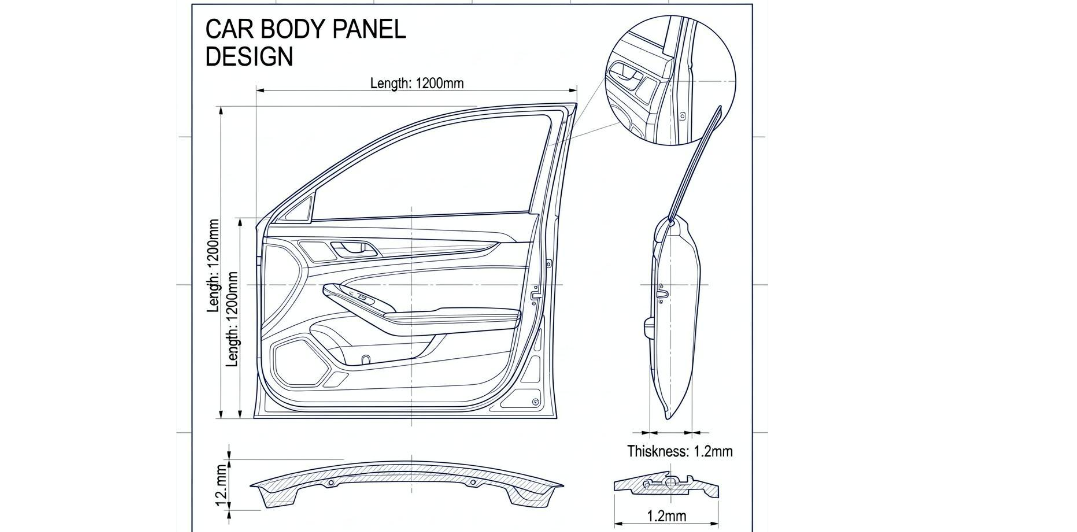
4. What dimensional tolerances can be achieved for automotive sheet metal parts?
Direct answer: For critical structural car sheet metal parts, tolerances of ±0.2mm to ±0.5mm are standard, with some applications requiring ±0.1mm for mating surfaces. Exterior body panels typically require ±0.5mm to ±1.0mm to ensure consistent gap and flushness.
Dimensional accuracy is paramount for assembly line efficiency and final vehicle quality. A 2024 study of automotive assembly plants found that each 0.1mm improvement in panel fit tolerance reduced in-line rework costs by 3.2%. The relationship between part size and achievable tolerance follows a predictable curve:
Verification: Reputable automotive sheet metal parts suppliers use coordinate measuring machines (CMM) and optical scanning to verify dimensional compliance. Jiangsu Yarujie operates a dedicated metrology lab with CMM accuracy to ±0.005mm.
5. How do you ensure surface quality and paint adhesion for body panels?
Direct answer: Surface quality is ensured through die surface polishing, controlled lubricant application, and protective film lamination. Paint adhesion requires a clean oil-free surface, with phosphating and electrocoating (E-coat) as standard pretreatment processes.
Surface defects are a leading cause of rework in automotive sheet metal parts. Industry data shows that 28% of exterior panel rejects are due to surface defects (scratches, dents, or waviness) originating in the stamping process. To prevent these issues, leading manufacturers implement:
- Die Surface Quality – Polished dies with Ra ≤ 0.2μm for exterior panels
- Controlled Lubrication – Consistent film thickness to prevent galling
- Protective Films – PE film application immediately after forming
- Cleaning & Pretreatment – Alkaline degreasing, phosphating, and E-coat for corrosion protection
- Surface Inspection – Automated optical inspection with AI defect detection
Best practice: For Class A exterior surfaces, Jiangsu Yarujie uses single-piece flow with dedicated inspection stations to ensure 100% surface quality check before packaging.
6. What is the typical production capacity for automotive sheet metal parts?
Direct answer: Tier 1 automotive sheet metal parts manufacturers typically operate with annual production capacities ranging from 5 million to 50 million parts, depending on press sizes, automation levels, and shift configurations.
Production capacity is a critical factor for supply chain planning. A 2025 industry analysis showed that automotive suppliers with fully automated stamping lines achieve 35% higher output per square meter of factory space compared to manual operations. Key capacity drivers include:
Jiangsu Yarujie operates a 35-mu facility with 18,000 square meters of standardized workshops, equipped with 15 stamping presses from 200 to 1,600 tons, supporting an annual production capacity of over 25 million car sheet metal parts.
7. What is the typical lead time for new automotive sheet metal part development?
Direct answer: Development lead time for a new automotive sheet metal part from drawing to production-ready typically ranges from 10 to 20 weeks, depending on part complexity, tooling requirements, and testing procedures.
The development process involves multiple phases: die design, material selection, tooling fabrication, tryout, and dimensional validation. Data from 2025 automotive sourcing reports indicates that suppliers using computer-aided engineering (CAE) simulation can reduce die tryout time by 40%, significantly shortening overall development cycles. The typical breakdown:
- Feasibility & Engineering – 2–4 weeks (CAE analysis, process design)
- Tooling Design & Fabrication – 6–10 weeks (die manufacturing)
- Tryout & Validation – 2–4 weeks (sample production, dimensional verification)
- PPAP & Approval – 2–3 weeks (customer submission and sign-off)
Accelerated development: Jiangsu Yarujie's in-house tooling capability allows concurrent die design and fabrication, reducing typical lead time to 10–12 weeks for standard body panels.
8. What quality control systems are in place for automotive sheet metal production?
Direct answer: Robust quality systems include IATF 16949 certification, in-process SPC monitoring, real-time defect detection, and PPAP documentation—ensuring consistent part quality throughout production.
The automotive industry demands the highest quality standards. IATF 16949-certified suppliers demonstrate a 52% lower defect rate in production compared to non-certified manufacturers, according to a 2024 quality benchmark study. Key quality control elements include:
Certification highlight: Jiangsu Yarujie holds IATF 16949 certification, ensuring full compliance with automotive quality management requirements. The company maintains PPAP level 3 submission capability for all new products.
9. What packaging and logistics considerations apply to automotive sheet metal parts?
Direct answer: Car sheet metal parts require specialized packaging including anti-rust VCI films, custom stillages or racks, interleaving paper, and protective edge guards—with just-in-sequence delivery often required for assembly line operations.
Packaging and logistics are critical to preserving part quality from factory to assembly line. Research shows that 18% of sheet metal part damage occurs during transit due to inadequate packaging. Common damage types include dents, scratches, and dimensional distortion. To mitigate these risks:
- VCI (Vapor Corrosion Inhibitor) Film – Prevents corrosion during ocean freight
- Custom Stillages – Reusable metal racks designed for specific part geometry
- Interleaving Paper – Prevents surface abrasion between stacked parts
- Edge Guards – Protect sharp edges from impact damage
- Just-in-Sequence Delivery – Parts delivered in assembly order for line-side consumption
Logistics capability: Jiangsu Yarujie provides export packaging certified for ocean and air freight, with a dedicated logistics team ensuring on-time delivery to assembly plants across 20 countries.
10. What is the supplier's capability in mold development and prototyping?
Direct answer: Full-service automotive sheet metal parts suppliers offer in-house mold design, fabrication, and prototyping—including soft tooling for small-batch validation and hard tooling for high-volume production.
Mold development is the most critical factor in stamping quality and efficiency. Suppliers with in-house tooling capabilities reduce overall project lead time by 30–40% compared to those outsourcing die fabrication. The mold development process follows a systematic approach:
| Phase | Activities | Typical Duration |
|---|---|---|
| Requirements | Drawings, CAE analysis, material specs | 2–4 weeks |
| Mold Design | 3D modeling, forming simulation | 4–6 weeks |
| Mold Fabrication | CNC machining, heat treatment, assembly | 6–10 weeks |
| Tryout & Validation | Sample production, CMM measurement | 2–4 weeks |
Jiangsu Yarujie specializes in both progressive and transfer die development, with in-house tooling capacity of 80–120 sets annually. The company's integrated approach—from mold development to mass production—ensures seamless quality control and supply chain efficiency for automotive clients worldwide.
Frequently Asked Questions
Q1: What are automotive sheet metal parts?
Automotive sheet metal parts are formed metal components used in vehicle bodies and structures, including body panels, frames, and structural reinforcements.
Q2: What metal is used for car body panels?
Steel (mild steel, high-strength steel, and AHSS) is the most common material, with aluminum increasingly used for hoods and doors in lightweight vehicle designs.
Q3: How are automotive sheet metal parts manufactured?
Through stamping processes including blanking, deep drawing, bending, piercing, and trimming, using progressive or transfer dies in mechanical or servo presses.
Q4: What is automotive metal stamping?
Metal stamping is a forming process that uses dies and presses to convert flat sheet metal into specific three-dimensional shapes for automotive applications.
Q5: What thickness is used for car body panels?
Outer body panels range from 0.6–1.0mm, structural components from 1.2–2.0mm, and reinforcements up to 2.5mm, depending on design requirements.
Q6: Do you provide OEM and ODM services?
Yes—full OEM and ODM services are available, including product design, mold development, stamping, welding, and assembly according to customer specifications.
Q7: Can you manufacture according to drawings?
Yes—our engineering team works from customer 2D drawings and 3D CAD models to develop stamping processes and tooling that meet exact specifications.
Q8: Can you support prototype production?
Yes—we offer soft tooling and rapid prototyping to support product validation, design verification, and pre-production sample delivery before mass production.
-
Address
No. 6, Xinggang Avenue, Baoying County, Jiangsu Province, China
-
Tel
+86 18852528888
-
Social media account

We welcome you to visit and inspect our company on site. Looking forward to becoming your partner.
Copyright 2025 JIANGSU YARUJIE AUTO PARTS CO., LTD. All Rights Reserved Wholesale Car Body Parts Manufacturer Auto Parts Export Factory
